Consignment, settled
One ledger for every shop that stocks your work.
Win the shop, put it on a route, record each visit, print the delivery note and know what it owes you. What was left, what sold, what was replaced and what is owed — recorded once, on the road, and agreed by both sides before anyone gets home.
Free under 25 stores. No card to start.
What it actually looks like
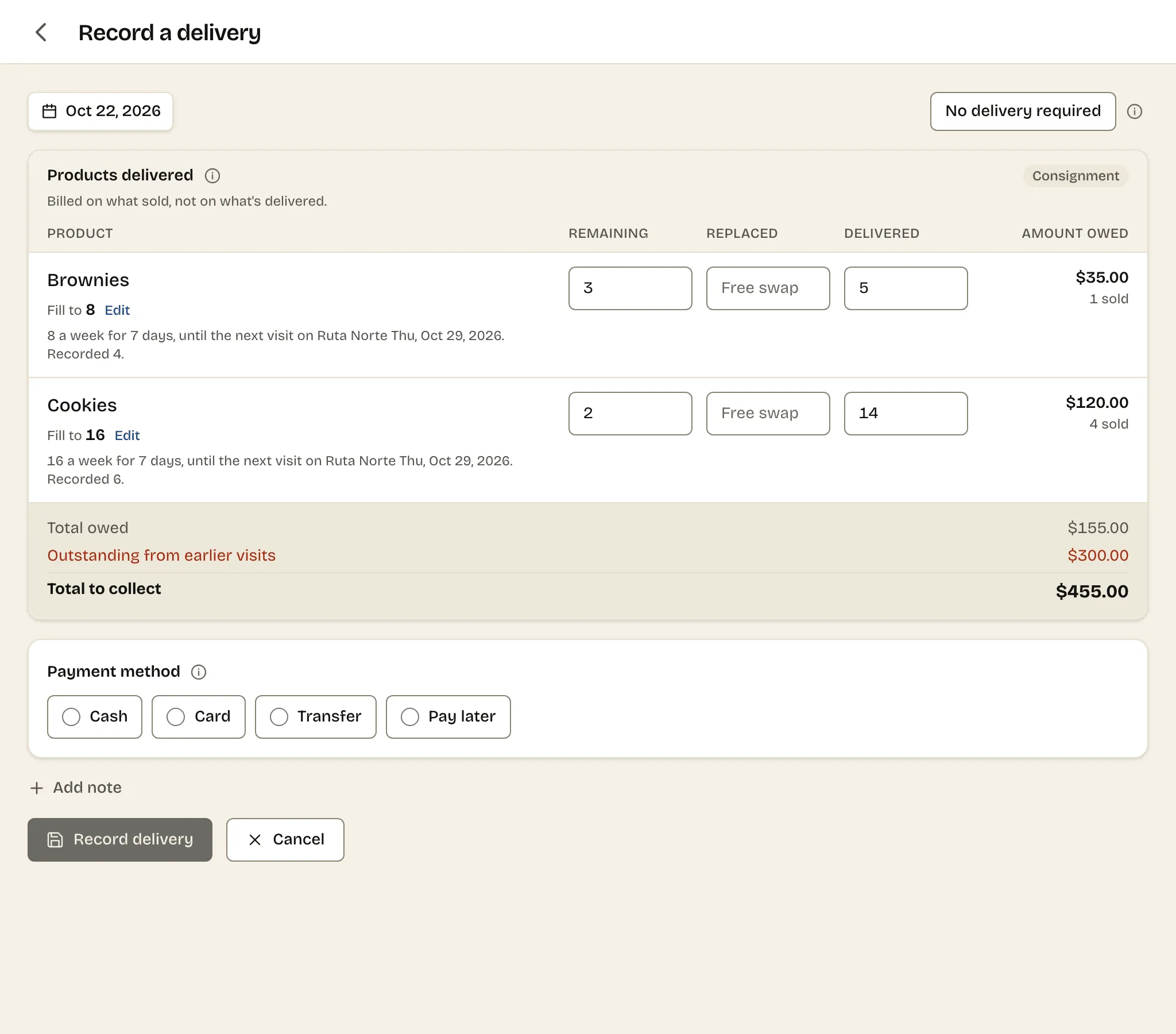
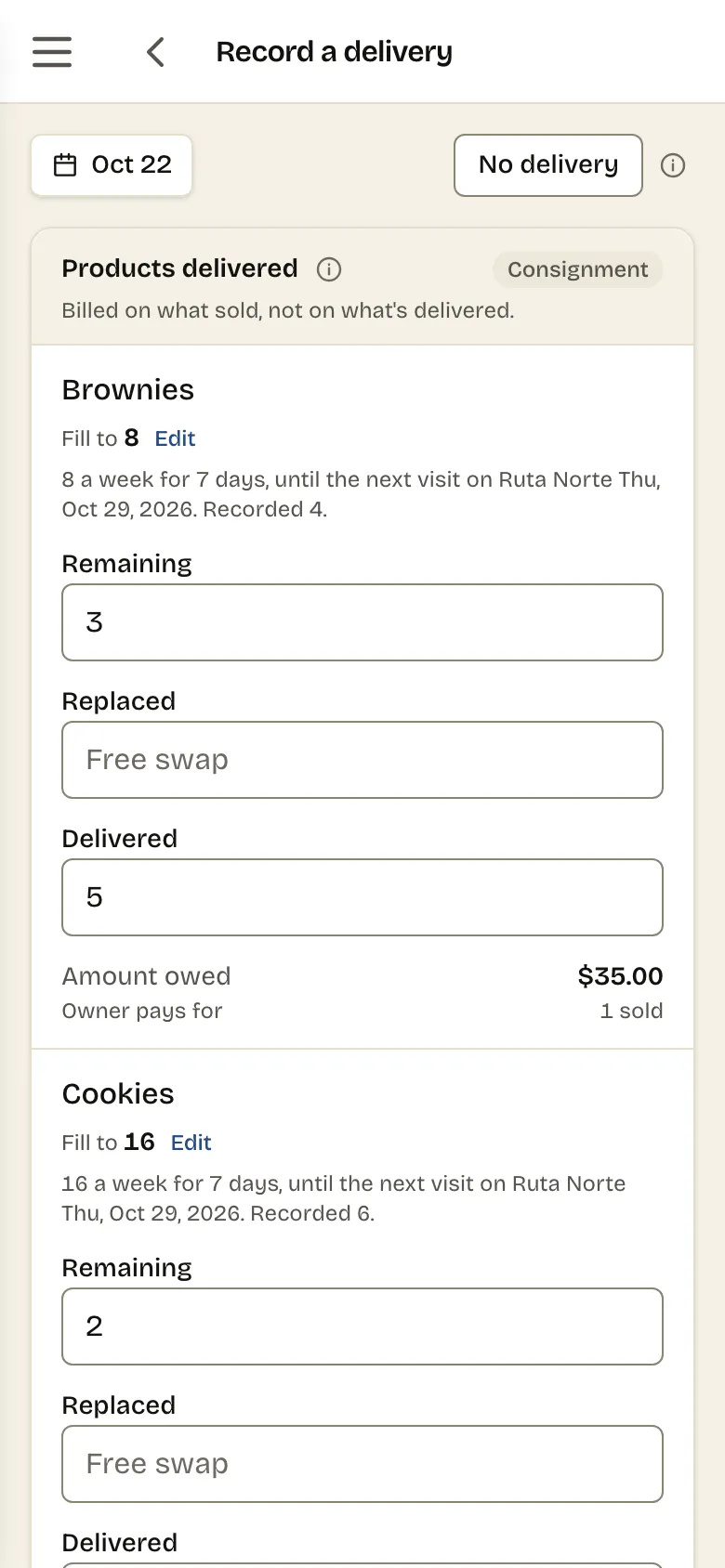
These are screenshots of the running app, not mockups. The delivery screen says the same thing this page does, in the product's own words: billed on what sold, not on what's delivered.
From a shop you want to a shop that pays
One record, from the first conversation to the commission. Each step hands the next what it needs, so nothing is typed twice and nothing lives in a notebook in the van.
1Win the shop
A pipeline for the shops that don't stock you yet: hot, warm or cold, a follow-up date, notes and contacts, and who owns each lead. Import a list, see it on a map, and keep a chain and its branches together.
2Put it on a route
A route has its cadence — weekly, fortnightly, monthly — a person responsible, and stops in the order you drag them into. Each shop is due from its own last visit, and Today shows which ones are.
3Run the route
Start a run and follow the stops in order, with a map. Record each visit as you go, then end the run and see the cash taken and the notes left along the way.
4Record the visit
Count what is left. The form suggests what to fill each product to: what that shop sells in a week, times the weeks until its next visit. Damaged or expired stock is swapped free, and a stop that needed nothing is recorded with its reason.
5Leave a printed note
The delivery note prints in the shop on a pocket Bluetooth thermal printer — from an Android phone, from an iPhone, or from a laptop. When the shop pays by transfer, the note carries the amount and your bank details.
6Know what is owed, and pay your Sellers
Paid at the visit in cash, card or transfer, or later, in part or in full; transfers wait until you reconcile them. Sellers earn a margin per unit on tiers by monthly volume, and each sees their own earnings.
Not ready for an account? These work without one:
The arithmetic, in the open
You arrive at the shop. You count what is still on the shelf. That is all it takes: what you recorded last visit, minus what is still there, is what sold.
One visit, with real numbers
- On the shelf last visit
- 24
- Still there today
- 9
- Delivered today
- 13
- Sold
- 15
- Price per unit
- MX$30
- Owed
- MX$450
Change what is still there. Then change what you delivered.
What you deliver today does not change this sum. That is why you can edit the delivered quantity and watch the amount owed sit perfectly still — you are looking at what sold, and delivered has nothing to do with it.
Free replacements are never charged. Damaged or expired stock you take away costs the owner nothing, under either arrangement.
For your trade
The sum is the same in all of them. What changes is what it is counted in and how often it is restocked. Each page carries that trade's own numbers.
What it does
Each one exists because something went wrong without it. These are the pages that explain them.
- Win new shops
A CRM for wholesale, built around the shops you visit
- Grow with commission sales
A tiered commission structure that adds itself up
- Send customers to shops
Answer where to buy once instead of every day
- Bill each shop right
Consignment software that bills each shop right
- Swap breakages for free
Damaged stock is swapped, never charged
- Different prices per shop
Every shop its own price and its own weekly sales
- Trust the people who sell for you
Give a Seller access without giving away everything
- Know what you are owed
Know exactly what every shop owes you
- Never miss a restock
Know which shops are due a restock today
- Hand prospecting to an AI
Let an AI assistant fill your sales pipeline
- Start the day knowing
One screen that says what to do today
- Leave proof behind
Print delivery notes on a portable receipt printer
- Plan the round, then drive it
Simple DSD software for producers' own rounds
Three things Artisanly does not do
All three are checkable. The first by opening any where-to-buy page; the third by signing up right now.
Publish your stockists' addresses
The public where-to-buy page shows a shop's name and its town. No street, no pin on a map, no opening hours. A stockist never asked to be listed, so the page says the least that still answers the question.
Show a Seller shops that are not theirs
The database enforces it rather than hidden buttons. A shop belonging to somebody else does not appear even if the address is guessed.
Ask you for a card
Free under 25 stores. Signing up asks for an email and a password. Nothing expires and nothing is charged.
What people ask before they start
- Does it work if some shops pay me cash up front?
- Yes. Each shop is direct or consignment: consignment is billed on what sold, direct on what you left. The bill follows the right basis without you having to remember which is which.
- Do I have to load my whole catalogue to begin?
- No. Start with one shop and one product. The sum works the same with one as with fifty, and you can add the rest as you go.
- Can I print a delivery note from an iPhone?
- Yes. On an iPhone you print through the Bluefy browser, or share a PDF from Safari to the printer's own app. Android prints straight from Chrome or through RawBT, and a laptop prints like any page.
- Does it work on a phone, without signal?
- It is built to be used standing up, one-handed, in a shop doorway. You need signal to save, but the screen is made to be read in daylight.
- What happens to damaged or expired stock?
- Free replacements are never charged, and they are not deducted from the bill either. They are recorded separately so you know what they are costing you.
- How are my Sellers paid?
- Each Seller earns the difference between the shop price and the partner price on every unit sold, priced by monthly volume tiers, with a separate schedule for when you deliver for them. Payouts are recorded against what they earned.
- Can a Seller see only their own shops?
- Yes, and the database enforces it rather than hidden buttons. Another Seller's shop does not appear even if somebody guesses the address.
Built by artisans, for artisans
Artisanly came out of a real cookie round, written by the people who drive it, replacing a spreadsheet that had stopped coping. Every rule in it exists because something went wrong without it first.