Damaged stock is swapped, never charged
A jar you replace because it broke is not a sale. It never reaches the bill and never earns commission — but it is counted, so a year of breakages is a number.
What you do today
You swap the broken one, mean to take it off the bill, and either forget and charge for it or take it off and lose any record that it ever happened.
One concrete detail
A replacement is its own quantity, not a sale priced at zero. It is excluded from the amount owed and from commission — because commission is earned on what the shop was charged, and the shop was charged nothing — while still accumulating on the shop's record where you can read the year's total.
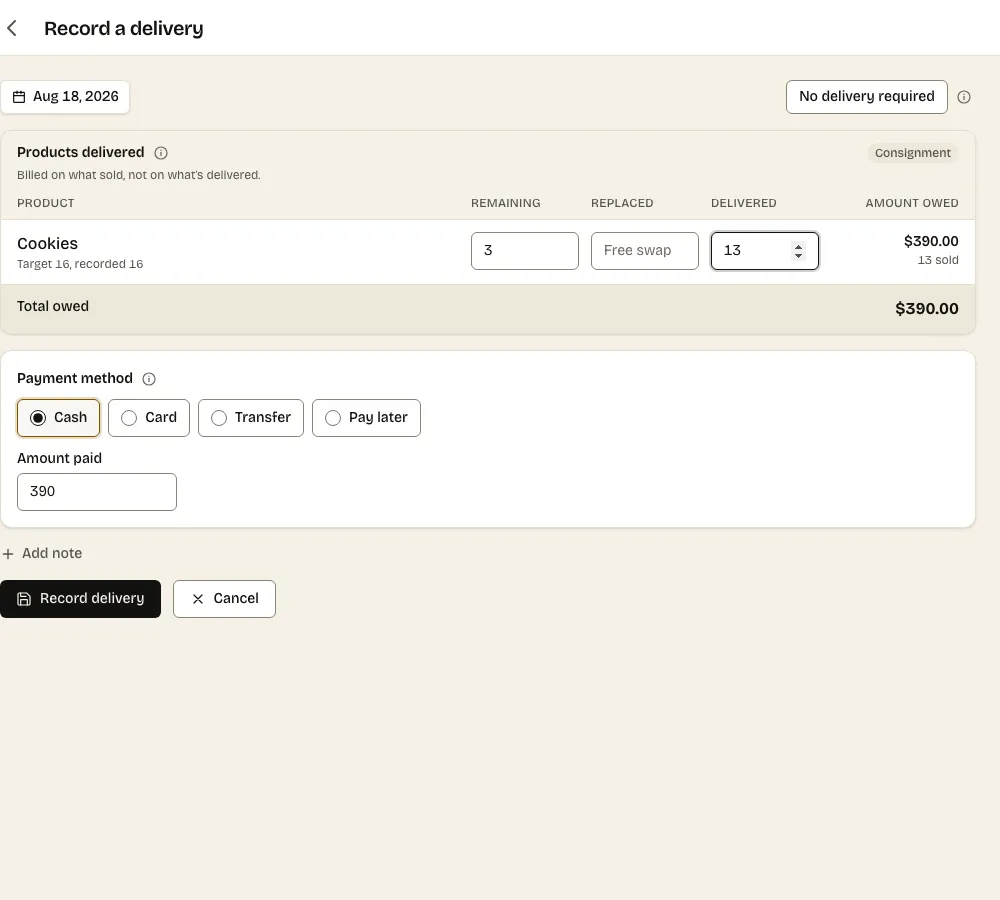
Something always breaks. A jar goes over on the shelf, a bag splits, bread goes stale a day before anyone buys it. You take the bad one away and leave a good one, because that is what you would want done for you.
Then you have to decide what that swap means to the bill — and the two obvious answers are both wrong.
The two ways it usually goes wrong
Charge for it. The count says one fewer on the shelf, the sum turns that into a sale, and the shop is billed for a jar nobody bought. The shop notices, sooner or later, and now the conversation is about whether your numbers can be trusted rather than about jam.
Take it off and move on. Correct on the day, and invisible after it. There is no record that it happened, so twelve months later you know only that you seem to be making more than you are selling. The shop that costs you two jars a month is indistinguishable from the shop that costs you none.
What actually happens
A replacement is recorded as its own quantity, next to what you delivered and what was left. It is not a sale priced at zero — it is a different thing that happens to cost the shop nothing.
That distinction is what makes the rest fall out on its own:
- It never reaches the amount owed. The bill is what sold, and this did not sell.
- It never earns commission. Commission is worked out on what the shop was charged. The shop was charged nothing, so there is nothing to earn a share of. Nobody had to write a rule for that; it is the same rule.
- It is still there to look at. Per shop, per product, accumulating. The number exists whether or not you want to read it today.
What the number is for
Breakage is a cost of doing business, and a small one per incident. It is worth counting for the same reason the counting visit is worth making: the pattern is the thing, not the event.
A shop that stores your product badly costs you steadily and never mentions it. A product that does not survive a summer in a shop with no air conditioning is a packaging problem, not a bad-luck problem. Neither of those is visible from a bill that has had the breakages quietly subtracted out of it — they are only visible if the swaps were counted separately in the first place.
Common questions
- Who pays for stock that breaks or expires in the shop?
- You do, and that is the normal arrangement on consignment — the goods were still yours while they sat there. What matters is that the swap is recorded rather than absorbed silently, so you know what it is costing you.
- Does a replacement show up on the bill?
- No. It is charged at nothing, so it never enters the amount owed. It appears on the delivery as its own column, which is how the shop can see you replaced something without being asked to pay for it.
- Does a driver earn commission on a replacement?
- No. Commission is earned on what the shop was charged, and a replacement is charged at nothing, so it earns nothing. That falls out of the rule rather than being a special case bolted on.
- How do I know what replacements are costing me?
- They accumulate per shop and per product rather than disappearing into the bill. A shop that quietly costs you two jars a month for a year is visible as a number instead of as a feeling that something is wrong.
- Is a replacement the same as a return?
- No. A replacement is stock swapped out and stock put back — the shelf ends up where it started. Stock you take away and do not replace is a fall in the count, which shows up as fewer units on the shelf rather than as a sale.