Every shop its own price and stock target
The price a shop pays and the quantity it holds belong to that shop, not to the product — so the deal agreed in March is the deal still billed in November.
What you do today
You keep the prices in your head, or in a note on your phone, and the shop that negotiated its own one gets whatever you can remember while you are standing at the counter.
One concrete detail
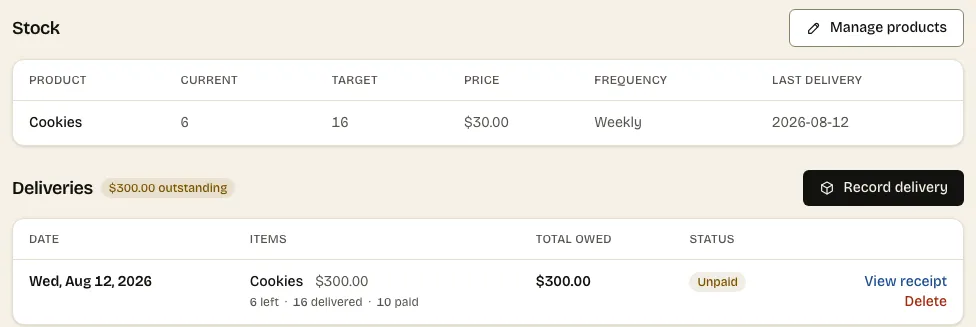
A price lives on the shop-and-product pair, not on the product. Changing your default price does not silently re-price the shop that agreed a different one, and a delivery is billed at the price recorded against that shop's row on the day it was recorded.
A price list is only simple until the second shop asks for a different number.
The cafe that takes twelve jars a week has a price. The shop across town that took six once and has not reordered has a different one. Neither of those is wrong, and neither of them lives on the product — they live on the arrangement between you and that shop.
What belongs to the shop, not to the product
Three things, and they are the three that make one shop different from another:
- The price it pays, per product.
- The stock target — how many it should be holding when you drive away.
- How often you restock it, which is what puts it on the right day’s round.
Your product catalogue holds the name, the unit and a default price. Everything else is per shop, because everything else was agreed with that shop.
Why the default is only a starting point
A default price is a convenience for setting up a new shop quickly. It is not the price of anything.
This matters most on the day you raise your prices. If the price lived on the product, putting the default up would silently re-price every shop, including the one you promised a fixed rate to and the one you are halfway through a trial with. Instead, raising the default changes what the next shop starts on, and existing shops keep what they were given until you change them deliberately.
The same rule protects your history. A delivery already recorded keeps the price it was billed at. Editing a shop’s price changes what happens on the next visit and nothing before it — so a receipt you handed over in March still says what it said in March.
The target is what makes the count useful
Counting what is left tells you what sold. It does not tell you what to leave.
The stock target closes that gap: it is the quantity that shop should hold, so the difference between the target and what you just counted is the number to unload. Six left against a target of sixteen is ten to top up, worked out while you are standing in front of the shelf rather than guessed from the back of the van.
Different shops carry different targets for good reasons — shelf space, how fast they move, whether the product keeps. A shop that sells four a week does not want sixteen sitting there going stale, and a shop that sells twenty does not want to run out on Thursday.
Common questions
- Can two shops pay different prices for the same product?
- Yes, and that is the normal case rather than the exception. Each shop carries its own price for each product it stocks. A shop with no price of its own falls back to the product's default.
- If I put my prices up, does every shop change?
- No. Raising the default price changes what a new shop starts on. A shop that already has its own price keeps it until you change that shop, which is the point — a price you negotiated should not move because you edited a different screen.
- What is a stock target?
- The quantity that shop should be holding when you leave. It is what turns a count into a delivery: you count what is left, and the target says how many to top it back up by.
- Can one shop take some of my products and not others?
- Yes. A shop carries the products you have given it, at the prices and targets you set for it. Nothing appears on a shop's screen that you have not put there.
- Does changing a price now change what I already billed?
- No. A recorded delivery keeps the price it was billed at. Editing a shop's price affects what happens next, not what already happened.