Give a driver access without giving away everything
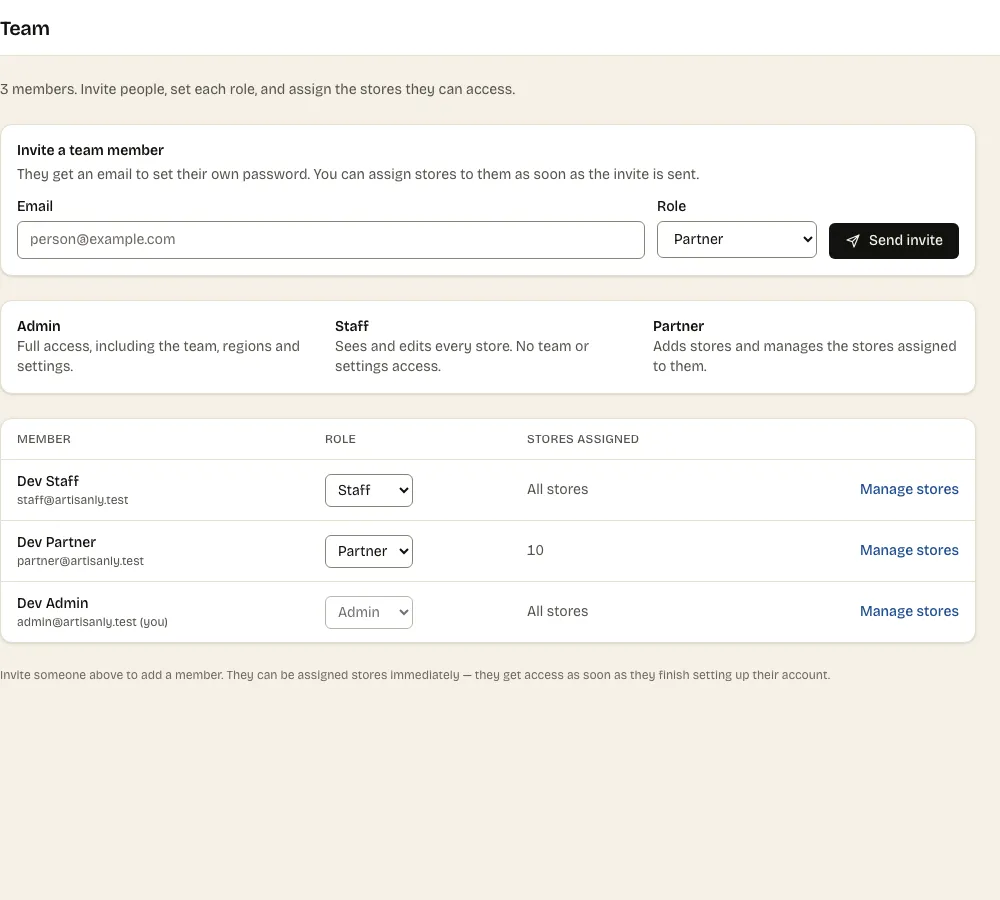
Per-store access enforced by the database rather than by hidden buttons, so another partner's shop does not appear at all.
What you do today
You share one login between everybody, or you send each person their own copy of the sheet and hope nobody opens the wrong tab.
One concrete detail
The rule lives in the database rather than in the interface, so a shop that is not yours does not appear even if somebody guesses its address and types it in directly.
This page targets no search term. Nobody types “per-store access control” into Google at seven in the morning. It is here because it is the question that gets asked in the first conversation with anybody who has a second driver, and the answer needs somewhere to live.
Enforced where it cannot be worked around
Most software hides what you are not allowed to see. The button disappears, the row is filtered out of the list, and the data is still there for anybody who asks the server directly.
Here the rule is in the database. A shop that is not assigned to you is not returned to you, by anything, ever — not by the interface, not by the public API, not by a guessed address typed straight into the bar.
Why it matters more than it sounds
The people you are giving access to are often not employees. They are a cousin, a neighbour’s son, somebody covering a route for a month. Trust is not the issue — the issue is that “please do not look at that” is not a security model, and neither of you should have to rely on it.
Common questions
- Can a partner see what another partner earned?
- No. Commission is visible to the person who earned it and to an administrator, and not across the team.
- What happens if somebody shares a link to a shop?
- The person opening it sees the shop only if the shop is assigned to them. A link is not access.